

TL;DR
- In-house billing provides direct oversight and control, but requires investing in internal staff recruitment and ongoing training.
- Outsourcing billing and collections can reduce staffing expenses and ensure dedicated follow-up; however, weigh provider fees against the challenges of maintaining oversight.
- A hybrid model delegates routine tasks to external partners, while internal staff focus on managing complex or high-priority cases.
- Evaluate providers based on transparent reporting, robust data security measures, and well-defined responsibilities.
- Select VoiceCom offers healthcare billing support, including insurer communication and assistance with patient payment plan enrollment.
Billing and collections are crucial to maintaining consistent revenue. Deciding between in-house management and outsourcing involves weighing direct oversight against specialised expertise.
This article compares in-house and outsourced strategies for cost, compliance, and denial management to support your decision-making process.
How Outsourced Billing and Collections Work in Healthcare
Medical billing covers tasks such as submitting claims, posting payments, and resolving discrepancies. Collections can include following up on unpaid insurer balances or working on patient balances.
Organisations that outsource medical billing services can delegate a specific queue or a broader set of tasks. For example, a provider might check claim status and document payer responses, then refer cases that need clinical records or an appeal decision. Your organisation sets the rules for system access and approvals, including who can adjust a balance or authorise a payment plan.
Comparing In-House and Outsourced Healthcare Billing and Collections
Each approach has specific advantages and trade-offs. Comparing teams handling similar tasks provides a clearer view of costs and performance.
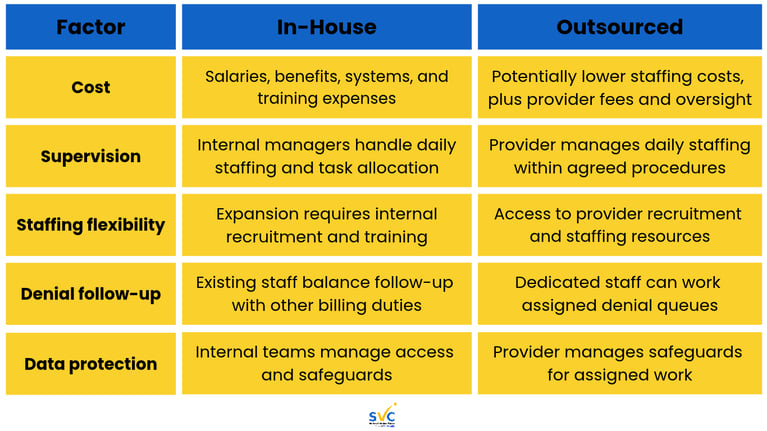 The most suitable approach reflects the work you need covered and the resources available to manage it.
Which Billing Model Fits Your Organisation?
In-house billing is appropriate when the team provides reliable coverage and regularly coordinates with clinicians or addresses policy exceptions. Before changing the staffing approach, consider whether adjusting work queues or enhancing training could resolve delays.
Outsourcing billing may be suitable when tasks are clearly defined and volume regularly exceeds internal capacity. If outsourcing collections, specify whether the scope includes insurer follow-up, patient account support, or third-party debt collection.
A hybrid model can address constraints limited to specific process steps. For example, an external team may check the status of aging claims while internal staff manages appeals that require clinical input. Clearly defining accountability for next actions helps prevent accounts from stagnating between queues.
What to Look for in a Healthcare Billing Outsourcing Partner
If you're considering outsourcing medical billing, assess how the provider handles accounts and coordinates with your team:
- Denial follow-up: Ask the provider to walk you through how they would handle a claim that requires additional documentation. Learn exactly who reviews the payer's response, and when your staff would step in to help.
- Reporting: Look at sample reports together. Ensure you can easily see which accounts are finished and which ones still need attention.
- Data safeguards: Ask how the provider protects your data, including who has access and what happens if there's a security issue. Don't forget to find out how your data will be returned or destroyed when the contract ends.
- Business associate arrangements: Make sure you have a written agreement in place if the provider will have access to protected health information. This is a key HIPAA requirement.
- Collections requirements: Double-check that only the necessary information goes to collection agencies, and that the provider follows all debt collection rules.
- Deadline ownership: Decide up front who will keep track of deadlines for payers. For example, Medicare usually requires claims within one year of the service date, with only a few exceptions.
Starting with a limited scope allows both parties to measure results and align expectations before expanding the partnership.
FAQs: In-House vs Outsourced Billing and Collections for Healthcare Organisations
1. What is the difference between in-house and outsourced medical billing?
In-house staff handle billing for your organisation. Outsourcing means a provider takes on agreed tasks, while your team oversees policies and approvals.
2. Is outsourcing medical billing less expensive than managing it internally?
Sometimes, but not always. Compare provider fees and coordination costs to the total cost of in-house staff and systems.
3. Can healthcare organisations outsource only part of their billing work?
Yes. A hybrid model lets an outside team do claim follow-up, while your staff handles complex appeals or account decisions.
4. Does outsourced billing include patient debt collection?
Not always. Check if the agreement includes insurer follow-up, regular billing support, or actual debt collection.
5. How can healthcare organisations evaluate an outsourcing provider's performance?
Look at denial resolution times, account accuracy, and costs. Compare similar workloads and note payments received versus balances reduced through write-offs.
Scope Your Healthcare Billing Support with Select VoiceCom
Identify which billing functions are best suited for external support. Select VoiceCom provides healthcare billing support, including communication with insurers and assistance with patient payment plan enrollment.
Now powered by The Office Gurus (TOG), the contact centre division of Superior Group of Companies, SVC combines its established outsourcing experience with TOG's broader resources and technology capabilities to support evolving customer service requirements.
Contact us or request a free quote to discuss your workload and explore outsourcing solutions tailored to your requirements.
MORE ARTICLES LIKE THIS

Streamlining Healthcare Operations at a Lower Cost: A Guide to Healthcare BPO Services
Administrative costs account for more than 40% of the expenses hospitals incur in delivering patient care, according to the American Hospital Association. Combined with rising labour costs and increasingly complex administrative requirements, these expenses continue to place pressure on hospital budgets and staff.

Why Healthcare Organisations Use Back Office Support to Improve Efficiency
Healthcare organisations are rethinking non-clinical staffing as workloads increase. Outsourcing back-office support helps manage these demands without growing internal teams. This article outlines how outsourcing works and why providers leverage it to improve efficiency.

How Medical Billing Outsourcing Helps Healthcare Organisations Reduce Costs
Modern businesses cite cost reduction as a primary reason for outsourcing. However, achieving real savings requires a proactive strategy that involves reorganising, optimising, and scaling operations.