

Outbound outreach supports several business functions, from prospecting and appointment setting to customer follow-up. However, managing these activities internally requires dedicated agents, training, technology, supervision, and enough capacity to maintain consistent outreach.
Outbound call center services provide another way to manage these responsibilities. Businesses can assign defined campaigns to trained external teams while retaining control over performance expectations.
This article explains how outbound call centers operate, the five key benefits of outsourcing, and what businesses should consider when managing an outbound campaign.
How Does an Outbound Call Center Work?
An outbound call center initiates calls to prospects or existing customers based on a defined campaign objective.
Agents work from approved contact lists and follow client-specific procedures. CRM and dialing technology can help organize contacts, document outcomes, and determine which prospects require another action.
Managers can then use campaign data to evaluate agent performance, contact outcomes, and areas requiring adjustment.
In-House vs. Outsourced Outbound Call Centers: What Works Best for Your Company?
An internal outbound team provides direct control over recruitment, management, and day-to-day operations, but the company must supply the necessary staffing, training, technology, and infrastructure.
Outbound call center outsourcing shifts selected operational responsibilities to an external provider. This can help when a company needs additional outreach capacity, specialized agents, or resources that would take time to build internally.
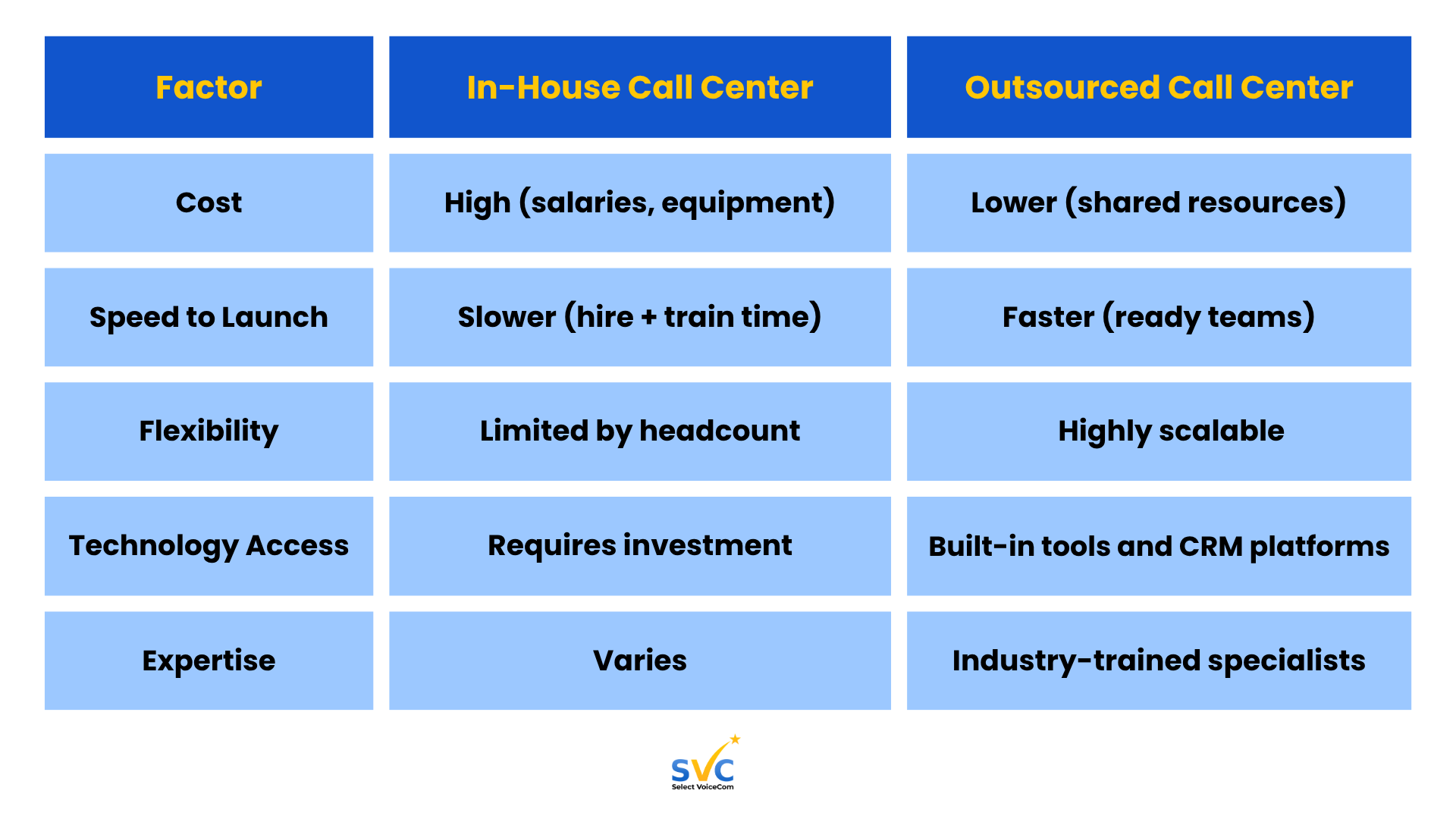 Neither model is automatically better. The appropriate choice depends on campaign requirements, internal capabilities, expected volumes, budget, and the level of oversight the business wants to retain.
What Services Do Outbound Call Centers Offer?
The scope of outbound work varies by provider and campaign. Common services include:
-
Sales Calls - Agents contact prospects to introduce an offer and determine interest.
-
Lead Generation - Outreach identifies potential customers and assesses them against agreed criteria before sales follow-up.
-
Appointment Setting - Representatives contact qualified prospects and schedule conversations with the appropriate internal team.
-
Market Research and Surveys - Agents gather structured information from customers or target audiences.
-
Account Management and Renewals - Teams conduct defined follow-ups related to existing accounts or upcoming renewals.
Companies can use outbound telemarketing services for individual campaigns or combine related functions according to their sales and customer engagement processes.
5 Benefits of Outbound Call Center Services for Your Company
Outsourcing gives businesses access to dedicated outbound resources. Its value depends on how effectively the external operation integrates with the company's existing sales and customer processes.
1. Control the Cost of Outbound Operations
Establishing an internal calling operation involves more than agent salaries. Businesses also need to account for recruitment, training, supervision, technology, workspace, and ongoing quality management.
An outsourced model consolidates many of these operational requirements under the provider. This gives businesses another cost structure to compare against maintaining equivalent capacity internally.
2. Maintain Consistent Sales Follow-Up
Sales opportunities can lose momentum when internal teams have limited time for repeated outreach.
Companies that outsource outbound sales calls can assign prospect contact and follow-up to agents dedicated to those activities. Sales representatives can then concentrate on qualified conversations and opportunities that require their direct involvement.
This division of responsibilities can make follow-up more consistent across the sales process.
3. Keep Customers Outreach Organized
Outbound campaigns are not limited to new sales. Businesses may need to reconnect with existing customers, conduct surveys, follow up on previous inquiries, or manage renewal-related communication.
A dedicated team provides a defined process for making these contacts and documenting outcomes. Internal teams can then see which customers have been reached and which require another action.
4. Increase Internal Team Capacity
Routine outbound activity can consume time that sales and other internal employees need for responsibilities requiring their expertise.
Delegating defined calling tasks gives those employees greater capacity for consultations, active opportunities, account management, or other higher-priority work.
The benefit comes from better work allocation, not simply increasing the number of calls made.
5. Maintain Consistent Brand Communication
Every outbound conversation represents the company.
Account-specific training, approved messaging, call monitoring, and ongoing coaching can help outsourced agents communicate according to established brand and campaign requirements.
Quality reviews also help identify where messaging or agent performance needs adjustment.
Key Performance Metrics for Outsourced Outbound Campaigns
Measure performance against the campaign objective, not call volume alone.
1. Contact Rate
Contact rate measures the percentage of attempted calls that reach the intended person. Changes in this metric can help identify issues with contact data, calling times, or campaign strategy.
2. Calls per Agent
This measures outbound activity over a defined period. It can provide useful productivity context, but businesses should evaluate it alongside contact and outcome measures rather than treating higher call volume as an objective on its own.
3. Average Handle Time
Average handle time measures the duration of an interaction and associated after-call work. The appropriate range depends on the campaign's complexity and purpose, so lower AHT does not necessarily indicate better performance.
4. Conversion Rate
Conversion rate measures how frequently calls produce the campaign's intended outcome. Depending on the program, that outcome could be a qualified lead, appointment, sale, completed survey, or renewal.
5. Follow-Up Outcomes
Tracking scheduled callbacks and subsequent outcomes can show what happens beyond the initial contact. This is especially useful for campaigns where prospects need several interactions before deciding.
Together, these metrics provide a more complete picture of campaign activity and outcomes.
How to Address Compliance in Outbound Campaigns
Outbound calling requires businesses and their providers to understand the laws and regulations that apply to the campaign.
In the United States, requirements may include the Telephone Consumer Protection Act (TCPA), federal and state Do Not Call rules, and privacy requirements governing customer information. Applicable obligations vary by campaign, technology used, jurisdiction, and contact type.
Caller authentication technologies such as STIR/SHAKEN can also affect how telecommunications networks identify legitimate calls.
Businesses should establish applicable compliance requirements before launching a campaign and confirm how prospective providers incorporate them into their processes. Outsourcing does not automatically transfer the company's legal responsibilities, so you may need an appropriate legal or compliance review.

Frequently Asked Questions About Outbound Call Center Services
-
What are the benefits of outbound call center services?
They can provide dedicated outreach capacity, organize prospect and customer follow-up, free up internal employees for other responsibilities, and provide access to established outbound processes and technology. -
Why do companies outsource outbound call centers?
Businesses may outsource when they need additional capacity or prefer not to establish the entire calling operation internally. The decision should depend on campaign requirements, available resources, and the provider's capabilities. -
Is outbound calling effective?
Its effectiveness depends on factors such as contact data, targeting, offer relevance, agent performance, calling strategy, and compliance. Businesses should define campaign objectives and track appropriate metrics to evaluate actual results. -
How can I improve an outbound campaign?
Review contact data, agent training, scripts, call outcomes, quality results, and campaign metrics regularly. Use those findings to identify specific changes rather than relying on call volume alone.
-
What should I look for in an outbound call center provider?
Evaluate relevant experience, agent training, quality management, technology, reporting, data security, compliance procedures, and the provider's ability to work within your campaign requirements.
Put More Structure Behind Your Outbound Campaigns
Select VoiceCom provides dedicated outbound teams for sales outreach, lead generation, appointment setting, customer surveys, and market research.
Our teams work within client-defined campaign requirements and are supported by account-specific training, quality management, reporting, and contact center technology. Businesses retain control over their objectives and sales strategy while SVC manages the agreed outbound functions.
Provide your sales and customer service teams more time for high-value interactions. Contact Select VoiceCom today to discuss your outbound campaign needs and request a free quote.